


Of all the cities of the Holy Land, none carries the weight of a single moment in history quite like Bethlehem. A modest town in the hills of Judea, it became the place where the Lord Jesus Christ was born into the world. Below is a look at the ancient town that received Him, the meaning of the manger, and the Church of the Nativity that still rises today over the spot of His birth.
Bethlehem
Bethlehem, meaning "the House of Bread" in ancient Aramaic (or more broadly, the house of special food), was a town of minor significance at the time of King Herod's proxy rule under the Roman Empire. The town's singular claim to historic fame before the rise of Christianity was its connection to the House of David, an era long gone by the time of the birth of Christ. In economic terms, the city was best known as a way station, a natural stop between Jerusalem and Hebron, made hospitable by its abundance of water.
Even so, the town of Bethlehem that the Holy Family arrived in to take part in Caesar's census was tiny by today's standards. It was little more than a cluster of homes and a small market. In fact, Bethlehem's claim to being a town most likely rested on the existence of a village gate, known today as the Al Zararah Arch, standing immediately north of the Nativity Church. That gate has served as the traditional entrance for all religious leaders on Christmas Day for time out of mind. The inn that the Holy Family could not find room in was most likely little more than a slightly expanded dwelling, built to serve the needs of caravans and passing travelers.
The Manger
As for the manger where Christ was born, the traditional imagery has shifted across the centuries between a cave and a wooden stable, depending on the culture and the imagination of the artist rendering the Nativity.
What we know of the setting of the Nativity comes from two Biblical sources: the Gospels of Luke and of Matthew. In the second chapter of Luke, the evangelist mentions an "inn." In the original Greek, the word can mean a place that lodges paying guests, or a way station for travelers, or even a section of a private home set aside for the accommodation of visitors.
So was the manger a stable, a cave, an inn, or a home?
In all likelihood it was a combination of at least two of these, if not three or all four. Most structures in Bethlehem were traditionally built into natural caves, and animals were often kept within living quarters for safety and warmth. To be quartered in such a setting would not have been unusual, especially with so many out of town families arriving for the official census at once.

Bethlehem Handicrafts' Hand Carved Olive Wood Nativity Set , a musical carved Nativity in a circular motion, available online. The olive wood Nativity is carved from Bethlehem olive wood in the city of Bethlehem itself. The ancient vivid cave expresses the birth of Christ, that great moment which is also the rebirth of love, hope, faith and peace. The glowing star of Bethlehem guides the shepherds of the Holy Land to the divine child, Jesus Christ. The most precious gift of the Holy Land is yours.
The Church of the Nativity
The Church of the Nativity in modern Bethlehem is a structure from the early fourth century AD, built over what has long been held as the place of the manger. Two locations within the Grotto are venerated with special reverence: the birthplace of Christ, the spot illuminated by the star of Bethlehem that the Magi followed, and the place where Christ was wrapped in swaddling cloths, a traditional way of protecting newborn infants from the cold, which lies only a few feet away.
The church is among the oldest in the world and has undergone remarkably few changes since it was rebuilt in the fifth century AD. Today the Church of the Nativity is second in importance only to the Holy Sepulchre in the Holy Land, and is visited by millions of pilgrims and local Christians every year, especially during the Three Christmases of Bethlehem: December 25 (Roman Catholic), January 7 (Greek Orthodox), and January 19 (Armenian).
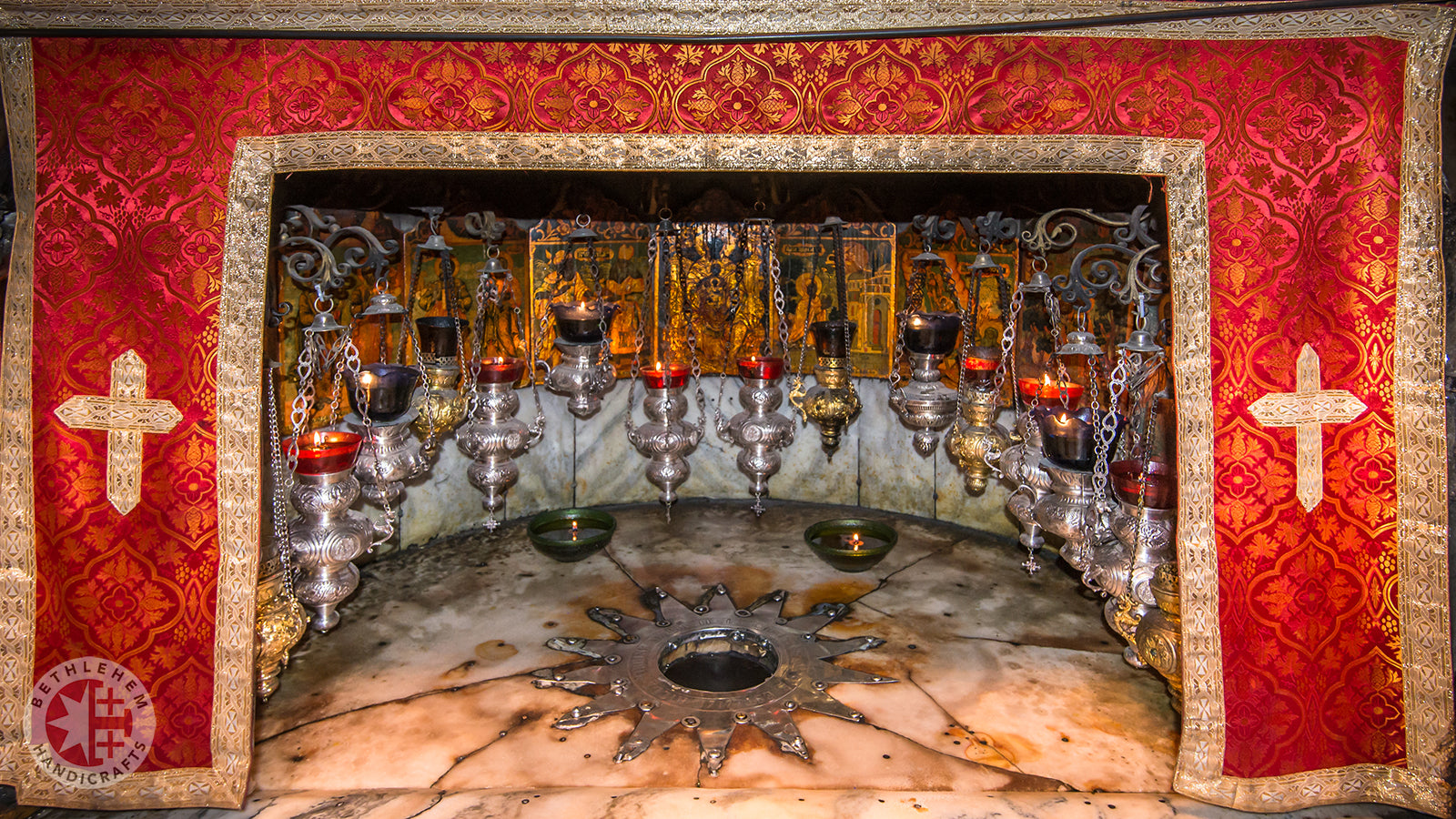
The fourteen pointed silver star beneath the altar in the Nativity Grotto marks the place of the birth of Jesus Christ by the Blessed Virgin Mary.
The Church of the Nativity may not bear much resemblance to a manger, yet it still serves as a place of veneration, prayer and contemplation for people from across the world who come to the Holy Land to better understand the gift of God's only begotten Son: Jesus Christ, the Prince of Peace and the Savior of Man.
We at Bethlehem Handicrafts are proud to put the Holy Land in your hand by giving you the finest original Bethlehem olive wood carvings, crafted with care in the Holy Land.
Made by Christian Hands. Loved by Christian Hearts.
Read Now: The Shepherds' Field in the Holy Land
0 comments